I Confused Learning With Scrolling
The more I've thought about it, the more I've come to realize that I've confused consuming media with learning. I've gotten very good at taking information in. What I haven't been nearly as deliberate about is creating the space to process it and put it into action.


Friday evening I came back to the hotel I am staying at, pulled into the parking area, and decided to check in on youtube. I'm a podcast addict and YouTube is my dealer. There is an endless supply of video content on skills I am working on: entrepreneurship, marketing, strategies for growth and pushing through the early stages. All of this is important to me, but somehow I got hooked into the "shorts". Thirty or forty minutes later, I was sitting in the same spot scrolling through nonsense. When I finally snapped out of it, I realized I had basically been in a trance.
Thirty minutes of my life had just disappeared. Poof. Gone. The more I've thought about it, the more I've come to realize that I've confused consuming media with learning.
The Consumption Trap
I consume a lot of information. In fact, one of my favorite ideas is that intelligence is the velocity of learning. This is the idea that your intelligence, your ability to navigate this complex world we live in, is directly proportional to your ability to learn and adapt quickly. I might have taken this idea too far.
I listen to podcasts while driving. I watch educational videos. I read books on my Kindle. I capture highlights in Readwise. I check email throughout the day.
Most of this doesn't feel like wasting time because the content is generally useful. I'm not so sure anymore.
At some point, listening to another podcast isn't learning. Reading another book isn't learning. Watching another video isn't learning. It's just consuming more information.
What I haven't been nearly as deliberate about is creating time to process what I've already consumed and put it into action.
Why Do the Good Ideas Come in the Shower?
There's that cliché about having your best ideas in the shower and I think there's something to it.
Some of my best thinking happens while I'm doing something completely mundane. I'm not trying particularly hard to think during those periods. There's just nothing else competing for my attention.
I'm a Gen X'er so for most of my life these little gaps probably occurred naturally. You stood in line. You drove somewhere. You walked somewhere. You waited for somebody. There wasn't always something to do. But now there is.
Every one of those spaces can be filled with a podcast, an audiobook, an E-mail, Facebook, YouTube, Google News, Kindle. Whatever.
We've become remarkably efficient at eliminating boredom and I'm convinced that was a mistake.
My realization on Friday was that boredom isn't wasted time, it's where the processing happens and I have been "optimizing" it right out of my life.
Putting Boredom Back In
I'm going to run an experiment for the next 30 to 60 days. In the same way that we create "wildlife refuge areas" I'm going to deliberately create "analog refuge areas"... periods in my day where I don't allow notifications or electronic consumption and I leave room for paper books and intentional boredom.
I'm starting with an hour before bed, banning podcasts as white noise at night and an hour after waking up.
No podcasts. No videos. No scrolling through the phone looking for something interesting. Just quiet, physical books and connection with the people I love.
The book one hurts a little because I love my Kindle. I've written about how much I love my Kindle. It's convenient, and more importantly, it connects beautifully with Readwise, where I've built a system for keeping my reading notes.
But Readwise can now scan highlights from physical books so the Kindle has lost one of its biggest advantages for me and a paper book has some enormous advantages over a screen:
A book is totally analog, there isn't an email hiding behind it, there isn't a notification waiting at the top of the screen, there isn't another app or distraction one swipe away to grab my attention and pull me into a half hour of nonsense.
Changing the Habit
I realize that I am squaring off against billions of dollars of tech innovation designed to hold my attention, keep me engaged, and as a result make me fail at this endeavor of resistance. But I feel like I'm equipped.
One of the early posts on this blog was a summary of Charles Duhigg's The Power of Habit and his model of the habit loop:
Cue → Routine → Reward
Seems relevant. The billions of dollars of engineering designed to make me check my phone is operating off of the same psychology I plan to use to build my analog refuge.
Checking my phone during an idle moment is a habit. Checking email before bed is a habit. Automatically putting on a podcast when I drive is a habit.
So rather than relying on discipline, I'm going to pay attention to the cues and rewards behind those behaviors and deliberately change the routines.
If you plan to do this too I will note that there is one important exception condition: emergency override.
I travel a lot, and I don't want my family unable to reach me because Dad has embarked on some experiment involving boredom.
So I plan to configure the phone so close friends and family can break through the notification restrictions when necessary. If anybody knows how to do this, I would appreciate some guidance (during the daytime tech-on hours of course).
Safety first. Boredom second.
Reclaiming My Time
I'm not particularly interested in becoming anti-technology. I need it, I use it, my business depends on it.
Technology has been enormously useful to me. I'm also not interested in competing with strangers on the internet to see who can achieve the lowest weekly screen-time report. That's not the experiment.
What I'm actually interested in is reclaiming some of the time and attention I've gradually surrendered to notifications, marketing, algorithms, and my own habits.
More importantly, I want to find out what happens when I stop immediately filling that reclaimed space with something else. Maybe nothing happens... maybe I just get bored.
But my experimental hypothesis is that I've spent years optimizing my ability to take in information while inadvertently reducing the amount of time available to actually think about it and turn it into useful actions and activities.
So for the next 30 to 60 days, I'm going to consume a little less and stare out the window a little more.
We'll see what happens. Wish me luck.
Ideas I’m Drawing From
One of the benefits of keeping highlights in Readwise is that I can go back and see the ideas that have been rattling around in my head—sometimes long before I realize they're connected.
A few that seem particularly relevant to this experiment:
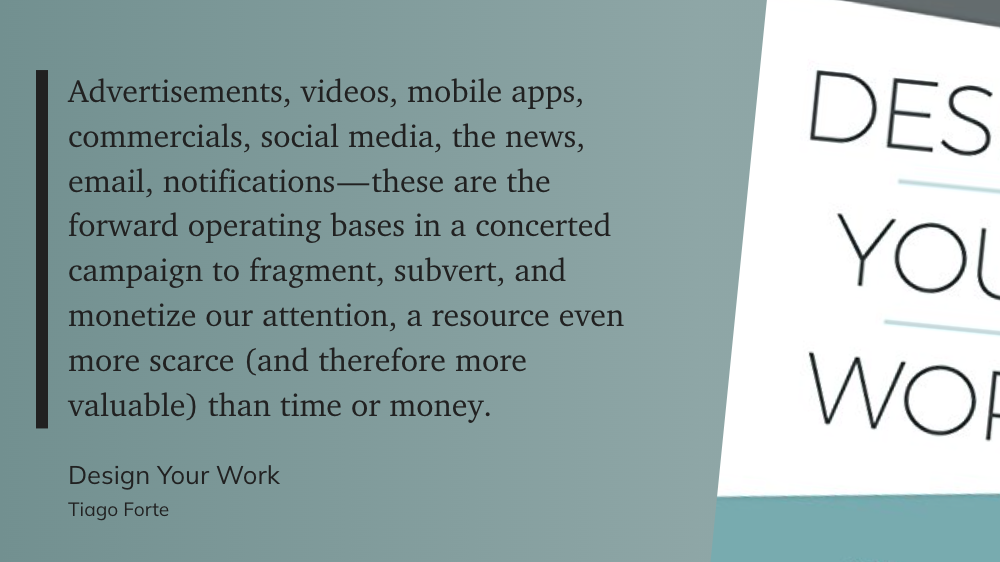
Tiago Forte — Design Your Work
“Advertisements, videos, mobile apps, commercials, social media, the news, email, notifications — these are the forward operating bases in a concerted campaign to fragment, subvert, and monetize our attention…”
Another Forte highlight comes remarkably close to my experience wasting time on Friday:
“We’ve made a habit of filling those hundred random spaces in our day with glances at Twitter, Instagram, and Facebook. But those glances have slowly become stares…”
Tiago Forte — Building a Second Brain
This one may be closest to the realization behind this experiment:
“We spend countless hours reading, listening to, and watching other people’s opinions about what we should do, how we should think, and how we should live, but make comparatively little effort applying that knowledge and making it our own.”
That's basically it.
I've gotten very good at consuming information. I'm less certain that I've protected enough time for making it my own.
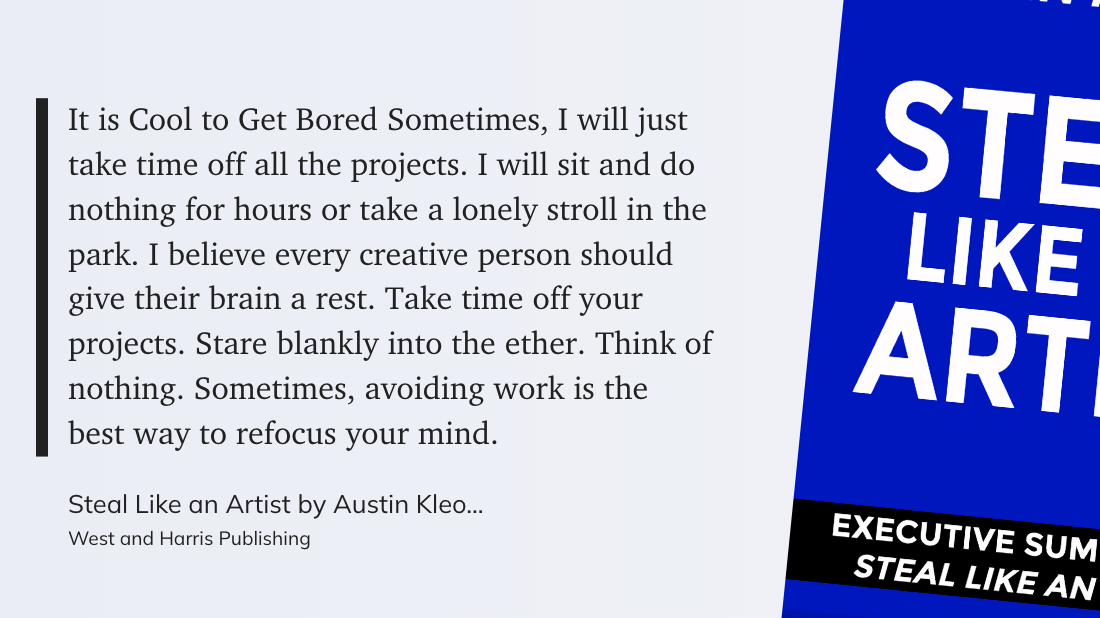
Austin Kleon — Steal Like an Artist
Kleon makes the case for something I've been systematically eliminating:
“I believe every creative person should give their brain a rest. Take time off your projects. Stare blankly into the ether. Think of nothing.”
And elsewhere:
“It is very easy to immerse and spend all your time hunched in front of your laptop. However, you need to remind yourself that your laptop does not produce ideas.”
Anna Lembke — Dopamine Nation
Lembke's description is considerably less gentle:
“The smartphone is the modern-day hypodermic needle, delivering digital dopamine 24/7 for a wired generation.”
That's useful context for why "I'll just check my phone less" probably isn't much of a protocol.
Charles Duhigg — The Power of Habit
This connects the observation to something I've used before:
“When a habit emerges, the brain stops fully participating in decision making… unless you deliberately fight a habit—unless you find new routines—the pattern will unfold automatically.”
That's why I'm approaching this as a habit-change experiment rather than a test of willpower.
